9K, 14K, 18K, 22K Gold — What the Karat Number Actually Means, and Why Higher Is Not Always Better
By Vaima Jewels editorial team · Updated · 6 min read
The karat number on your jewellery tells you exactly how much gold is in the alloy. It does not tell you how durable it will be, how long it will stay bright, or whether it will hold a diamond securely. Those answers live in the part the number does not measure.
6 min read
All Buyers
Metals · Buying Guide
Pure gold is almost useless for jewellery. At 24 karats — 99.9% gold — it bends under finger pressure, scratches from a fingernail, and cannot grip a prong-set stone for more than a few weeks of daily wear. Every piece of gold jewellery you have ever owned was an alloy: gold mixed with other metals to give it the hardness, colour, and workability it needed to survive on a body. The karat number tells you the ratio of that mix. It measures gold content. Nothing else.
What the karat number does not tell you is what fills the remaining percentage — and that gap in information is where most buying mistakes happen. A 9K gold ring contains 37.5% gold and 62.5% of something else. That something else, and how it behaves against your skin, in Mumbai's humidity, under a stone setting, across five years of daily wear, determines whether a piece holds up or doesn't.
"The question was never how much gold is in it. The question was always what the rest of it is, and what it does to your jewellery over time."
The Four Karats
Gold Content, BIS Hallmark, and What Each Alloy Actually Does
Avoid9KBIS 375Nine karat gold
Gold Content
37.5% gold · 62.5% base metals
Hardness: Very hard — but for the wrong reason. High base metal content (copper, zinc, nickel) makes it rigid and brittle, not resilient.
Tarnish risk: High. With over 60% reactive base metals, 9K tarnishes noticeably within 12 to 18 months of daily wear. Surface discolouration and skin staining are common.
Stone setting: Poor. Prongs work-harden and become brittle, increasing stone-loss risk over time.
Price: Lowest of the four. Often marketed as budget-accessible fine jewellery by newer Indian brands. Lowest resale value per gram.
BIS status: BIS hallmarkable in India under 375 stamp. Legally permitted but not the Indian market standard.
Not recommended for fine jewellery with set stones. Adequate for plain chains or bangles where tarnish is acceptable.
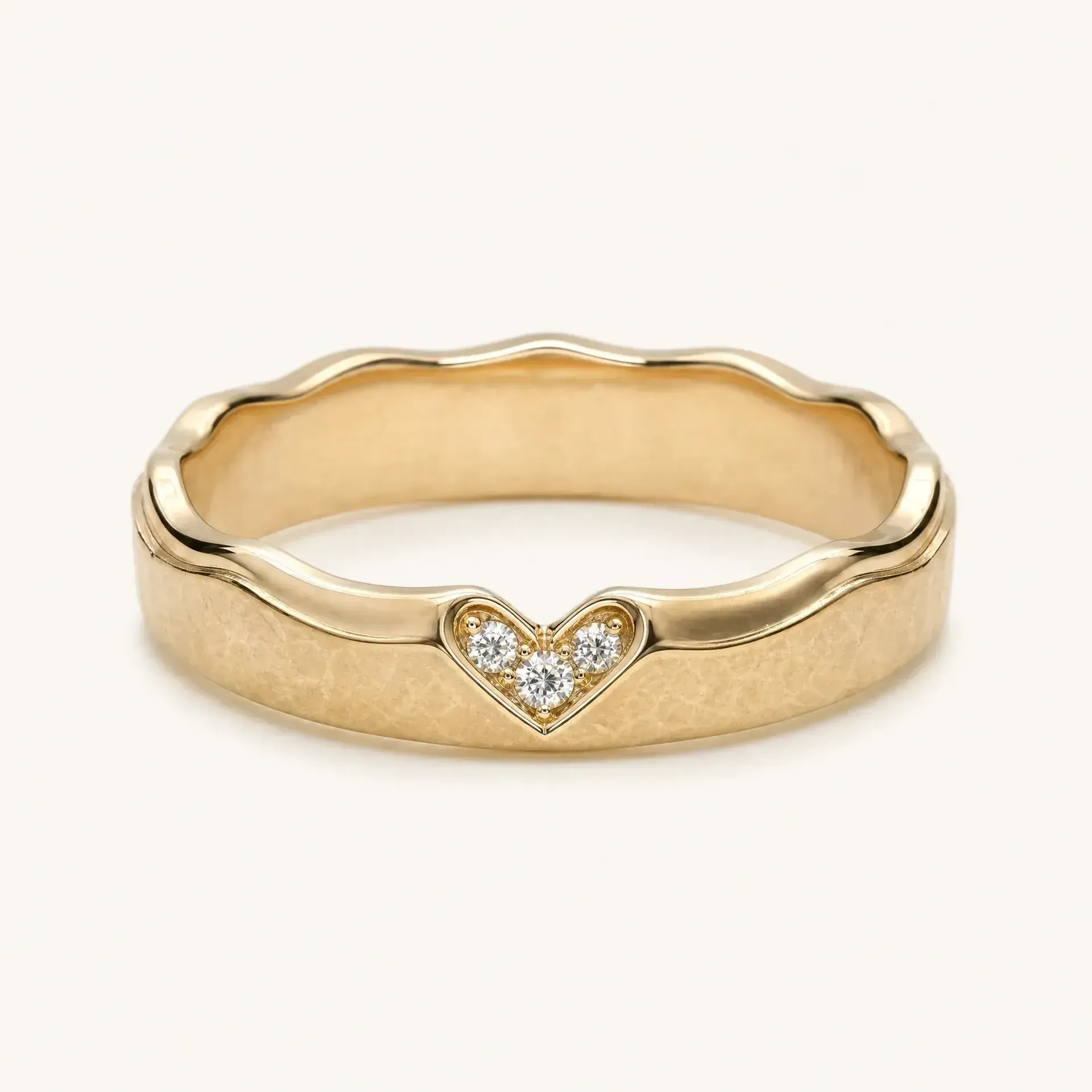
VAIMA Choice14KBIS 585Fourteen karat gold
Gold Content
58.5% gold · 41.5% alloy metals
Hardness: Highest wearable hardness among gold alloys. Resists scratching from daily contact, bags, gym equipment, and work surfaces.
Tarnish resistance: Excellent. Gold content is high enough to resist oxidation from sweat and humidity across years, not months.
Stone setting: Best of all gold karats. Prongs hold tension without becoming brittle. Pavé, bezel, and claw settings all perform reliably long-term.
Price: Mid-range. Meaningfully more affordable than 18K for similar visual result. Strong value proposition for daily wear.
Daily wear reality: Maintains finish longest under real conditions. The standard in the US and European jewellery markets precisely because durability was the design brief.
VAIMA's choice for all gold jewellery. Best balance of durability, tarnish resistance, stone security, and value.
Popular18KBIS 750Eighteen karat gold
Gold Content
75% gold · 25% alloy metals
Hardness: Good for jewellery but softer than 14K. Daily wear accumulates surface scratches faster, especially on high-polish finishes.
Tarnish resistance: Very good. Higher gold content means even less reactive surface area than 14K. Imperceptible difference in real-world conditions.
Stone setting: Good, but prongs slightly more prone to deformation over years than 14K. Requires periodic checking for heavy daily pieces.
Price: Roughly 25 to 30% more expensive than 14K at same weight for similar visual output. Premium is real, not perceptible to eye.
Market position: Dominant in Indian fine jewellery. Most established brands, including Tanishq, use 18K as their diamond jewellery standard.
Excellent choice. Genuinely premium product. The price premium over 14K is real — decide whether the additional gold content matters to you.
Hardness: Softest of all four options. Bends, dents, and scratches easily under normal wear. Unsuitable for daily-use rings or bracelets with active lifestyles.
Tarnish resistance: Best of all four — the high gold content leaves almost no reactive base metal exposed. Gold itself does not tarnish.
Stone setting: Poor to unusable. Prongs deform too easily to hold stones securely in active wear. Most 22K pieces are plain or set with very small stones in bezel settings only.
Investment value: Highest gold content per gram. Best instrument for gold-as-commodity investment. Closest to pure gold for resale, gifting, and melt value.
Indian context: Dominant in bridal, temple, and heirloom jewellery where wearability is secondary and gold content as store of value is primary.
Not for daily fine jewellery with diamonds. Right choice for bridal bangles, necklaces worn occasionally, and family heirloom pieces.
Side-by-Side Comparison
Every Variable That Matters for the Indian Buyer
Factor
9K (375)
14K (585)
18K (750)
22K (916)
Gold content
37.5%
58.5%
75%
91.6%
BIS Hallmark
375
585
750
916
Hardness (Vickers)
~120–150 HV Brittle
~120–150 HV Resilient
~125–135 HV Good
~70–90 HV Soft
Tarnish timeline (daily wear)
12–18 months Fast
5–10+ years Slow
5–10+ years Slow
Minimal Very slow
Stone-setting suitability
Poor
Excellent
Good
Poor
Daily wear durability
Moderate
Best
Very Good
Low
Skin sensitivity risk
Highest – Nickel present
Lowest
Low
None
Investment / resale value
Lowest
Moderate
High
Highest
Price (relative, same weight)
Lowest
Mid
High
Highest
Common use in India
Emerging
VAIMA standard
Traditional standard
Investment / Bridal
Tarnish Reality
What Actually Happens to Each Karat Over Time
Tarnish in gold jewellery does not come from the gold. Pure gold is chemically inert — it does not react with oxygen, sweat, chlorine, or skin acids. Every tarnish event in a gold alloy comes from the base metals in the remaining percentage reacting with the environment. This is why the tarnish timeline is almost directly proportional to base metal content.
9K
Fast Tarnish
62.5% base metals. Copper oxidises to greenish deposits. Zinc dulls quickly in humidity. In Mumbai, Bengaluru, or Chennai conditions, surface discolouration can appear within 12 months of daily wear. Skin staining (green or grey) reported frequently. Cannot be re-polished indefinitely as gold layer is thin.
14K
Slow Tarnish
41.5% base metals, but alloy composition is engineered for resistance. In normal daily wear conditions, a 14K piece maintains its finish for 5 to 10 years before requiring professional cleaning or polishing. Not immune — heavily exposed pieces (rings, especially in humid coastal cities) benefit from periodic cleaning.
18K
Very Slow Tarnish
Only 25% base metals. Visibly and meaningfully better tarnish performance than 14K, but the difference in daily wear conditions over a 5-year window is marginal. The improvement matters most in heavy-contact pieces like rings. Imperceptible in earrings, pendants, or lightly worn pieces.
22K
Minimal Tarnish
8.4% base metals. Best tarnish resistance of all four. Will maintain colour and brightness for decades in occasional wear. However, the softness means surface scratches accumulate fast — and a scratched matte surface can look duller than a clean 14K high-polish piece within the same timeframe.
The VAIMA Position
Why VAIMA Only Offers 14K Gold
Every decision to exclude a karat was deliberate. Here is the reasoning behind each one.
Why Not 9K
9K became fashionable with a wave of Indian D2C brands positioning it as accessible fine jewellery. The positioning is honest on price. Everything else about 9K compromises the product. At 37.5% gold, the alloy contains enough reactive base metals to tarnish within one to two years of daily wear in Indian conditions. Prongs become brittle and increase diamond loss risk. Skin reactions from nickel content are well-documented.
A lower entry price that requires replacement or repair within two years is not affordable. It is expensive twice.
Why Not 18K
18K is an excellent product and VAIMA respects it. For diamond jewellery in daily wear, 14K outperforms it on hardness and stone retention while the real-world tarnish difference is negligible. The price premium for 18K at the same design — roughly 25 to 30% more at the same weight — goes to gold content you cannot see, feel, or wear differently. VAIMA's pricing commitment makes the 14K decision straightforward: better durability, lower cost, same visual result.
18K is not wrong. 14K at the same quality of craftsmanship is simply more rational for daily wear.
Why Not 22K
22K gold cannot hold a diamond securely in any setting meant for daily wear. Prongs made in 22K deform under normal activity. The metal is too soft to maintain the precision setting geometry that keeps a stone in place over years. VAIMA sets IGI-certified diamonds. Choosing a metal that cannot protect that setting would contradict everything the product stands for. 22K's strengths — high gold content, bridal weight, investment value — are real, but they belong to a different product category.
22K's ideal context is bridal and heirloom. VAIMA's context is daily wear. These are different briefs.
Investment Reality
What Gold Jewellery Is and Is Not as an Investment
This is the question most jewellery buyers ask. The honest answer is rarely the one they receive in a jewellery store.
What Jewellery Is Not
Jewellery is not a gold investment vehicle. When you buy a piece of gold jewellery, you pay for the metal weight plus making charges of 8 to 30% of the metal cost, plus 3% GST on the total. When you sell or exchange it, you recover metal value only — making charges are gone. Net position on day one is negative by 8 to 35% before any wear or time depreciation. This is true across all karats and all price points. The higher the making charge, the larger the immediate loss position on resale.
What 22K Does Better
Among the karats, 22K comes closest to a gold-as-commodity position. Its 91.6% purity means that when it is exchanged or melted, a greater percentage of what you paid in metal cost is recovered. If investment or resale value is your primary purpose, 22K plain jewellery — bangles, chains, bars — is the right instrument. Gold ETFs and Sovereign Gold Bonds are a better instrument still, with zero making charge, zero GST on gains, and perfect liquidity.
What 14K and 18K Are Good For
14K and 18K jewellery is a wearable object, not a financial instrument. The correct question for these karats is not "what will I recover when I sell it" but "what is the daily experience of wearing something well-made for years." On that framing, 14K is exceptional value. The gold content retains meaningful resale potential as exchange credit with most jewellers. But you are buying an object whose value is in how it lives on your body — not how it performs on a balance sheet.
The 9K Investment Trap
9K jewellery marketed as accessible fine jewellery with an implicit promise of gold value is misleading. At 37.5% gold, its commodity metal value is already the lowest of the four. Add that it tarnishes faster, requires maintenance sooner, and has the lowest resale rate of any gold karat in Indian exchange markets — the combination means a 9K buyer pays fine-jewellery prices for a product that performs more like fashion jewellery over time. The price looks right. The outcome rarely is.
Common Myths
Six Things Most Buyers Believe About Gold Karats That Are Not True
MythHigher karat means better gold jewellery.
Higher karat means higher gold content. That is different from better jewellery. 22K gold is the worst karat for daily-wear jewellery with set stones. It scratches easily, deforms under normal activity, and cannot maintain a secure stone setting. The finest diamond ring in the world set in 22K gold will lose its stone faster than the same ring in 14K. Karat measures purity. Quality of jewellery is determined by craftsmanship, setting technique, and the suitability of the alloy for its intended use.
Myth14K gold is not real gold. It is mostly other metals.
14K gold contains 58.5% pure gold — more than half the alloy by composition. It carries the BIS 585 hallmark, is legally certified gold in India, and is the dominant fine jewellery standard in North America and much of Europe. The idea that it is "not real gold" comes from confusing gold content percentage with gold authenticity. 14K is real gold. It is alloyed gold, as are all jewellery-grade metals. Even 22K contains 8.4% non-gold metals.
Myth9K gold is a good entry-level option for fine jewellery.
9K gold is priced at entry level. The product experience is not fine jewellery. With 62.5% base metals, 9K tarnishes significantly faster than 14K or 18K, especially in India's humidity. Skin staining, surface discolouration, and prong failure under stone settings are documented patterns. Brands positioning 9K as accessible fine jewellery are accurate on price and inaccurate on product category. It behaves more like premium fashion jewellery with a two to three year lifespan than fine jewellery meant to last a decade.
Myth18K and 22K look richer / more yellow than 14K.
The colour difference between 14K and 18K yellow gold is real but barely visible in normal wear conditions. Both appear yellow gold to the naked eye. The difference is detectable when pieces are held directly side-by-side in good lighting — not in wear. The difference between 18K and 22K yellow gold is more visible due to the step-change in gold content. However, colour is also controlled by the specific alloys used in each formulation, not just by karat. A well-formulated 14K yellow gold can appear warmer than a poorly formulated 18K.
MythKarat and carat mean the same thing.
They sound identical and are spelled almost identically, but measure different things entirely. Karat (K) measures gold purity — the ratio of gold to other metals in an alloy. Carat (ct) measures diamond weight — the mass of a gemstone, where 1 carat equals 0.2 grams. A 14K gold ring with a 0.50ct diamond uses both measurements for completely separate purposes. Confusing the two leads to real misunderstandings when reading product specifications or certificates.
Myth22K gold is the best investment in jewellery form.
22K is the best karat for gold-as-commodity in jewellery form — but jewellery is still a poor investment vehicle compared to alternatives. Every piece of jewellery sold in India carries 3% GST and making charges ranging from 8 to 35% of metal cost. These costs are not recovered on resale or exchange. If gold exposure as an investment is the goal, Sovereign Gold Bonds (tax-efficient, liquid, earn 2.5% annual interest) or Gold ETFs (real-time pricing, no making charges) are structurally superior. 22K jewellery is a meaningful commodity store only when the making charges are low — as in plain bangles and chains — not in worked or diamond-set pieces.
Buying Scenarios
What to Choose Based on What You Actually Need
Scenario 01
Daily-wear fine jewellery with set diamonds — rings, earrings, bracelets
Choose 14K gold.
Best hardness for stone security. Slowest scratch accumulation. Tarnish resistance that holds across India's climate over years. The global standard for exactly this use case. At VAIMA, 14K is the only option for good reason — it is the right material for the brief.
If the piece will be worn daily, 14K still outperforms on long-term durability. If it is a piece worn occasionally — a necklace for events, a ring for special days — 18K's higher gold content is a legitimate indulgence. The visual difference is minimal; the emotional weight of 18K is real for some buyers.
Scenario 03
Bridal jewellery — wedding set, family gifting, heirloom investment
22K for plain pieces. 18K for set-stone bridal jewellery.
22K bangles, necklaces, and chains carry the right cultural weight and commodity value for Indian bridal gifting. For diamond-set bridal jewellery intended for daily wear after the wedding, 18K holds stones better. Do not set significant diamonds in 22K — the setting will not hold in active daily wear.
Scenario 04
Budget-conscious first gold purchase — considering 9K as an entry point
Do not buy 9K. Buy 14K at smaller scale instead.
A 0.5g 14K gold studs pair outperforms a 1g 9K pair in every measurable way over 3 years: finish retention, stone security, skin compatibility. The savings from 9K are spent on maintenance, replacement, or disappointment. Scale down the weight — not the karat — to find a price that works.
The karat number tells you how much gold went in. Durability, tarnish resistance, and stone security tell you what comes out of wearing it every day. Those two things are not the same calculation — and confusing them is where most jewellery regrets begin.
VAIMA Standard14K gold · BIS 585 hallmarked · HUID-registered
Gold Content58.5% pure gold per alloy weight
Verify HallmarkBIS Care app · HUID number on every piece
Pricing BasisIBJA daily rate · Live metal cost on every PDP