Every clarity grade on a diamond certificate was assigned by a gemologist holding a loupe to a stone under a bright, controlled light, magnified ten times. That is the only context in which FL, VVS, VS, SI, and I grades mean what the scale says they mean. In real life, a diamond sits in a setting, on a hand, under office tube lights or afternoon sunlight, viewed at arm's length without magnification. Two very different environments. One grade trying to describe both.
This gap between the certificate and the real world is where most clarity decisions go wrong — and where most jewellers quietly benefit from buyers who do not know what to ask.
The Clarity Scale, Briefly
The IGI and GIA clarity scales run from Flawless to I3. In practice, for anyone buying fine jewellery for daily wear, the relevant range is VS1 to SI2. Everything above VS1 is grading what only a loupe can find. Everything below SI2 carries a real risk of inclusions visible without any magnification at all.
The Scale
IGI Clarity Grades — What Each Actually Means
The Two Things the Certificate Does Not Tell You
Here is what separates a working diamantaire from someone who has just memorised the grading scale. Every inclusion has two attributes that the clarity grade alone does not capture: what type it is, and where it sits inside the stone. Both matter more than the grade itself when it comes to what you actually see and feel wearing the piece.
Two stones can share an identical SI1 clarity grade and look completely different to the naked eye. One will be genuinely eye-clean because its inclusion is a tiny pinpoint near the girdle edge, sitting under a prong. The other will show a visible dark crystal dead in the centre of the table. Same certificate grade. Entirely different stones.
"The clarity grade tells you the size of the problem. The inclusion type tells you whether it absorbs light or reflects it. The position tells you whether anyone will ever actually see it. You need all three."
What the Trade Knows
Inclusion Types and Their Effect on Light
Not all inclusions dim a diamond equally. Here is how the trade thinks about them — and what most buyers are never told.
Crystal
High impactA trapped mineral crystal inside the diamond — often looks like a tiny dark or white dot. Dark crystals absorb light directly. White crystals reflect it back irregularly, creating dead spots in brilliance.
A central crystal in an SI1 stone will look worse to the eye than a peripheral cloud in a VS2. Grade alone is misleading here.
Feather
High impactA small internal fracture. When it catches light it can flash white — which some people find beautiful. When it doesn't, it creates a dark linear shadow. In I clarity, feathers can affect structural durability.
Ask where the feather sits. A feather near the girdle under a prong is irrelevant. A feather running across the table in SI1 is a different conversation.
Cloud
Medium impactA cluster of tiny pinpoints too close together to resolve individually. Small clouds are often invisible. Large or dense clouds create a milky or hazy appearance that dulls the stone's brilliance without appearing as a discrete inclusion.
A "cloud" on the certificate is worth asking about. Some cloudiness only appears in very specific lighting — others are visible in all conditions.
Needle
Medium impactA thin elongated crystal inclusion resembling a fine rod. Unlike a flat feather, needles are three-dimensional and often catch light from multiple angles, creating small but persistent reflective interruptions.
A needle cutting through the table facet affects brilliance more than an equal-sized pinpoint. The grade does not distinguish between them.
Pinpoint
Low impactA single tiny crystal, so small it appears as a dot under magnification. Most pinpoints are invisible in wear and have negligible effect on light performance.
An SI1 stone with multiple pinpoints near the girdle is a genuinely good stone. Ask to see the plotting diagram to confirm this is what the grade represents.
Graining / Internal Graining
Medium impactIrregular crystal growth that creates faint lines or streaks within the stone. Common in lab-grown CVD diamonds at SI clarity. Not a foreign object — part of how the crystal grew. Can cause a faint haze under certain light angles.
Graining in lab-grown diamonds is different from feathers or crystals. It rarely affects everyday appearance but is worth understanding when buying CVD SI clarity stones.
Position Changes Everything
Once you know what type of inclusion a stone has, the next question is where it sits. The IGI certificate includes a plotting diagram — a small schematic of the stone with inclusion locations marked. Most buyers ignore it. Most buyers should not.
Inclusions near the girdle edge are often partially or completely hidden by prongs in a claw setting, or by the bezel in a bezel setting. Inclusions at the very tip of a pear or marquise cut sit under the protective V-prong and are invisible in wear. A crystal near the culet (the bottom point of the stone) can create a visual effect where the inclusion appears to be multiplied as light bounces around the pavilion — one small inclusion that looks like several from above.
A stone with an SI1 grade whose inclusions are all at the girdle under prong positions is a better practical choice than a VS2 stone with a small crystal sitting directly under the centre of the table. The grade on the certificate will tell you the opposite. This is exactly the kind of knowledge that stays inside the trade.
Common Myths
Clarity Beliefs Worth Questioning
Shape Matters
Minimum Clarity by Diamond Shape
The same clarity grade shows differently depending on the shape of the stone. Step cuts expose inclusions that brilliant cuts hide. Here is the practical floor for each shape.
Round Brilliant
VS2 minimum
SI1 if well-positioned
The 58 facets scatter light aggressively, hiding most inclusions at SI1. Eye-clean SI1 rounds are genuinely common. This shape is the most forgiving on clarity.
Oval
VS2 minimum
SI1 with plotting check
Modified brilliant faceting hides inclusions similarly to a round. SI1 is workable but check that inclusions are not sitting in the centre third of the stone where the bowtie shadow is already a concern.
Cushion
VS2 minimum
SI1 with caution
The larger facets on some cushion cuts expose inclusions more than a round. Modified brilliant cushions hide inclusions better than crushed ice or chunky facet patterns. Check the specific facet style before going SI1.
Princess
VS1 minimum
Corner facets in a princess cut concentrate light in ways that can make inclusions near the corners more visible. Inclusions at the corners also increase chipping risk at those already-vulnerable points. Do not go below VS1.
Emerald / Asscher
VS1 minimum
VS2 only with expert review
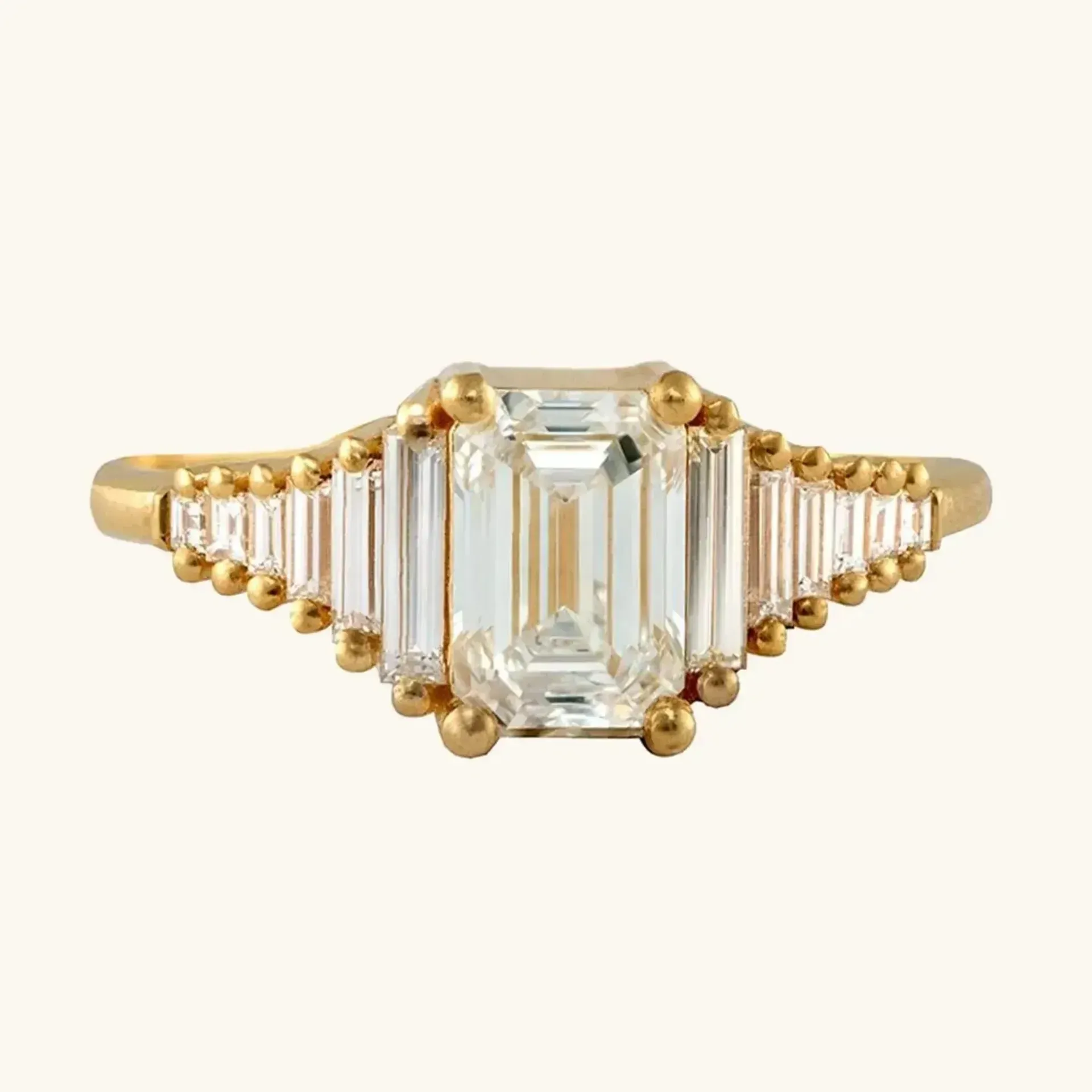
Step cuts are glass windows into the stone. The large open facets that create the hall-of-mirrors effect also make every inclusion plainly visible. An SI1 emerald cut will show its inclusions to the naked eye in almost all cases. This is non-negotiable.
Pear / Marquise
VS2 minimum
SI1 only under prong areas
The pointed tips of these shapes sit under protective prongs — inclusions at the tips are hidden in wear. However, inclusions in the centre belly of these shapes are more exposed than in a round. Check the plotting diagram specifically for the central zone.
Clarity vs Colour — Which Trade-Off Makes More Sense
When budget forces a choice between spending on clarity and spending on colour, most buyers instinctively protect clarity. This is the wrong instinct. Colour is visible from a distance in face-up viewing. An H-colour stone in a white metal setting will show more warmth to a casual observer than a VS2 stone will show its inclusions to anyone without a loupe.
The practical hierarchy for most buyers is to spend on cut first, then protect colour down to G or H, and only then consider clarity. A G-colour VS2 in an Ideal cut beats a D-colour VVS1 in a Very Good cut in every real-world wearing condition that matters.
Buying Scenario 01
Round brilliant, daily wear ring, moderate budget
SI1 with a reviewed plotting diagram. Redirect budget to cut grade.
A round brilliant hides SI1 inclusions effectively. Request the IGI plotting diagram, confirm inclusions are not central, and put the saved budget toward Ideal cut. The result is a more brilliant stone than a VS2 in a Very Good cut at the same price.
Buying Scenario 02
Emerald or Asscher cut, any budget
VS1 minimum. Non-negotiable for step cuts.
Step cuts have no facet scatter to hide inclusions. An SI1 emerald cut will almost certainly show inclusions in normal lighting at arm's length. If budget does not allow VS1 in a step cut, switch shapes rather than drop clarity.
Buying Scenario 03
VVS1 vs VS2 — same stone shape, significant price gap
VS2 every time. Put the difference into cut or carat.
Both VVS1 and VS2 are completely eye-clean. You cannot see the difference with your naked eye in any real-world lighting. The price premium for VVS1 exists because the certificate says something impressive. It does not exist because the stone looks better.
Buying Scenario 04
Lab-grown CVD stone at SI1 clarity
Check inclusion type on the certificate. Ask specifically for graining vs crystal vs feather.
CVD SI1 inclusions are often graining — diffuse, low-impact, and genuinely eye-clean in wear. But some CVD SI1 stones carry clouds that create haze under certain lighting. The grade alone does not tell you which you have. The inclusion type description on the certificate does.